

Searchlight Institute recently released a study on how to build a supermajority of the American electorate which was featured in The New York Times. More in Common was the research and methodology partner for this work. Our Executive Director Jason Mangone and US Head of Research Ashley Fabrizio share more about how More in Common approached this project and what we’ve learned about American voters.
Before you dive in, don’t miss our webinar on Thursday, October 8th from 2-3pm ET where we’ll be discussing our latest research with FOX Sports Official on sports fandom and community belonging.
A large part of More in Common’s work is simply exposing the truth of peoples’ views beyond their politics. Our national conversation tends to use the labels “Democrats” and “Republicans” to describe people, when in fact these labels describe political parties that reflect the views of a smaller and smaller slice of voters every day. As our politics have become increasingly nationalized, our parties have become less and less representative of Americans. The mislabeling that undergirds our politics has become so inaccurate that it makes More in Common’s job quite easy at times—of course Americans hold more in common than the simple Democrat versus Republican story allows for.
Most of our work is pre-political: it focuses on deepening our understanding of one another. To the extent we work with one side of the partisan divide or another, we try to help both of our parties to become more reflective of their voters—to help “Democrat” and “Republican” once again become labels that are capacious enough to contain the multitudes demanded of a 350-million-person democracy with only two main parties.
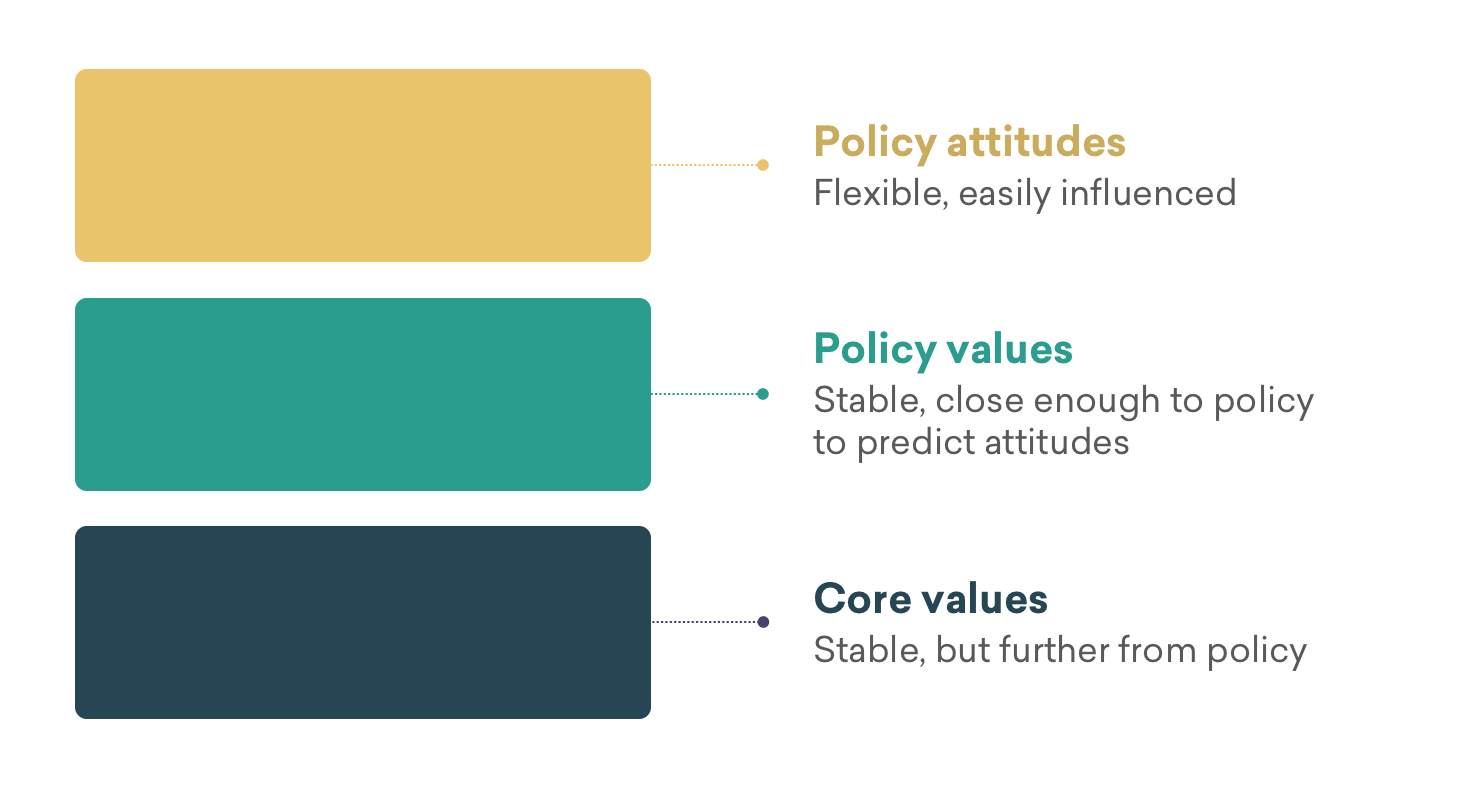
To become more representative of voters, parties require a deeper understanding of why Americans hold the policy positions they do. Policy attitudes can be surprisingly fickle. They can swing based on the news cycle, how a question is framed, or who is making the argument. Values move more slowly. They’re more stable over time and less easily swayed by what’s happening in the moment; they’re more deeply held. Understanding values tells us not just where voters stand on today’s issues, but how they’re likely to approach new ones, and where they might land tomorrow.
To understand the upstream drivers of the electorate’s policy attitudes, we worked with Searchlight Institute to build a policy segmentation that can help us better identify unexpected combinations of policies that might earn supermajority support from new, politically diverse coalitions of Americans. Unlike our Hidden Tribes work, which is built on core values, this policy segmentation stays closer to policy: policy values are stable enough to be longstanding and evergreen, yet specific enough to remain close to our fundamental governance debates. They sit between our policy preferences and core values. They are applied values, institution-oriented and governance-oriented, about how government should work, and they cut across multiple policy domains. Policy values sit on a spectrum, like law-and-order vs. a more open society, more vs. less government intervention in sustaining people’s finances, and government focus on global engagement vs. domestic priorities.
This policy segmentation, like all the segmentations we do at More in Common—including Beyond MAGA, Hidden Tribes, and those for partners (e.g., around AI attitudes)—gives us a powerful tool to map peoples’ values and worldviews. With it, we can better understand the distinct ways that different groups respond to public policy proposals, reforms, and debates. People have different values and orientations to society, and these differences profoundly shape their feelings about all sorts of issues from climate and culture wars to immigration and the role of government. National segmentations like this one can help give us a handle on the main differences within our population, helping us design more effective strategies that start with people’s values at the center.
This policy segmentation was based on two national surveys of 2028 likely voters (N=5,807 and N=3,068) and qualitative panel research with N=316 Americans, conducted from June-August 2026.
Here’s what we found and how it surprised us:
1. Five policy values are at the heart of our core policy debates.
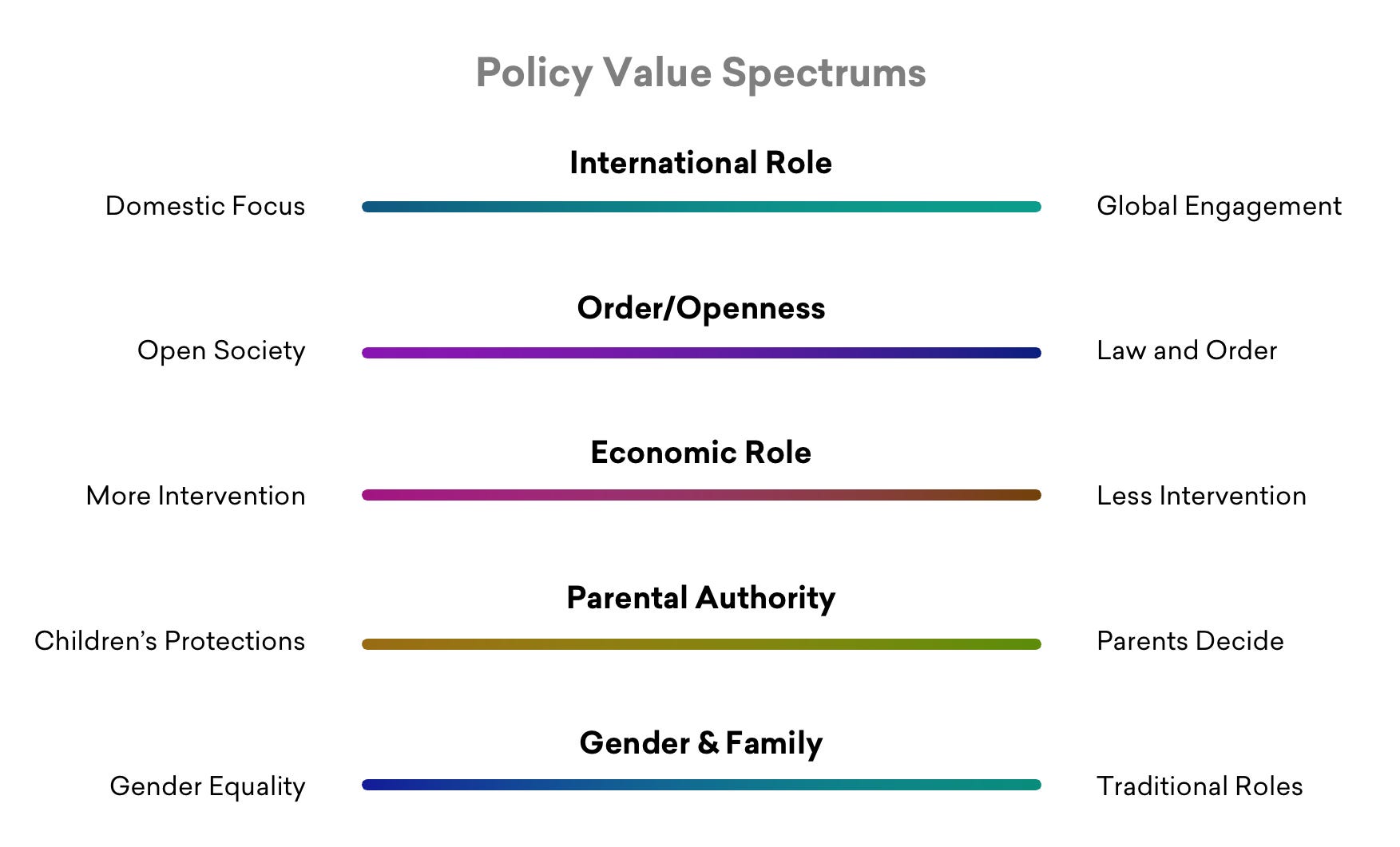
As we constructed it, policy values capture a tradeoff that people weigh in deciding what they want government to do. When the government has to choose, what should be the priority? Should the government, for example, play an active role in the economy, or should it take a limited role and rely more on businesses and markets?
Of the five policy values at the heart of our core policy debates, we expected to see that government’s Economic Role, emphasis on Order/Openness, and International Role would be important, unique underlying dimensions of our national policy debates, but Gender & Family and Parental Authority surprised us in being so core to Americans’ political intuitions. Many Americans feel strongly one way or the other as to whether the government should prioritize advancing gender equality vs. traditional gender roles, and whether the government should let parents decide what their children can do vs. protecting children’s choices or privacy.
2. From these five policy values, we identified 9 segments of Americans and their proportion of the electorate.

Which segment are you? TAKE THE QUIZ HERE.
We identified nine groups of Americans who tend to see government and public policy in different ways. (Learn more about each segment here.) The groups are based on the combinations of values, priorities, and beliefs people bring to questions about government, not simply their political party or ideology. They help us understand why people who vote differently may agree on some issues, why people in the same party may want different things, and where there may be unexpected opportunities for common ground.
We were surprised to find areas of overlap between the more right-leaning and left-leaning segments. For example, Lawn Sign Liberals (mainstream liberals who place particular importance on privacy, personal choice, and free expression) share an unexpected libertarian streak with Cul-de-Sac Conservatives (the most consistently conservative and Republican group). Both groups favor personal freedom, oppose wealth caps, are relatively comfortable with markets, want government out of parental discipline, and favor parents having access to information about their children.
And No Trespassing Populists (financially strained conservatives who feel ordinary Americans are squeezed by rising costs and overlooked by the government) overlap with more liberal segments like the Liberal Arts Left, Lawn Sign Liberals, and The Neighborhood Watch on redistribution, climate action, and gun restrictions—even as they align with more conservative segments on immigration enforcement, voter ID, school prayer, public order, and traditional family roles.
3. Issues like healthcare and AI regulation reveal surprising areas of cross-partisan alignment and potential for building a supermajority coalition.
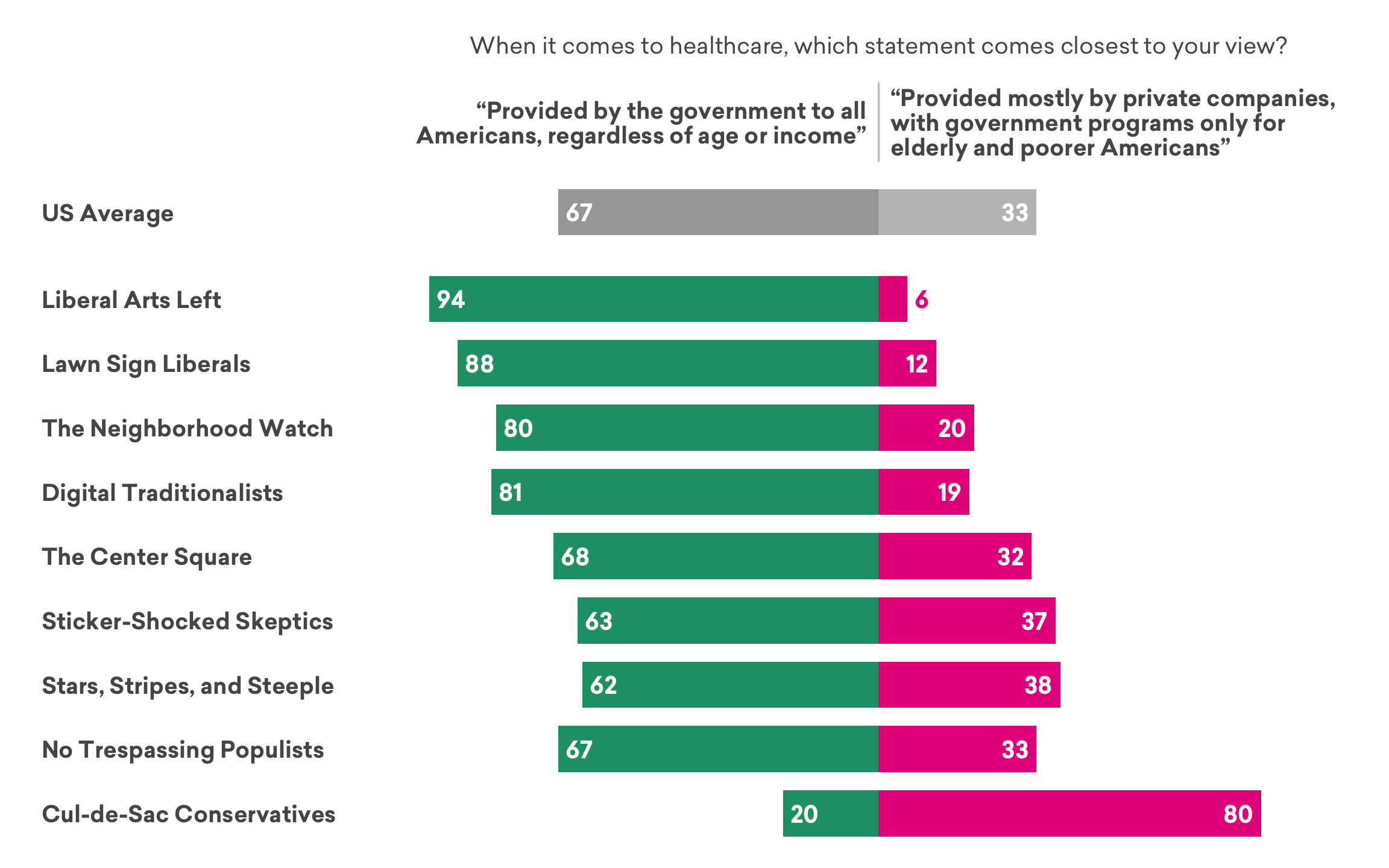
Two in three Americans (67 percent), including majorities of most of our policy segments, want the government to provide healthcare for all Americans, regardless of age or income, compared to the healthcare status quo.
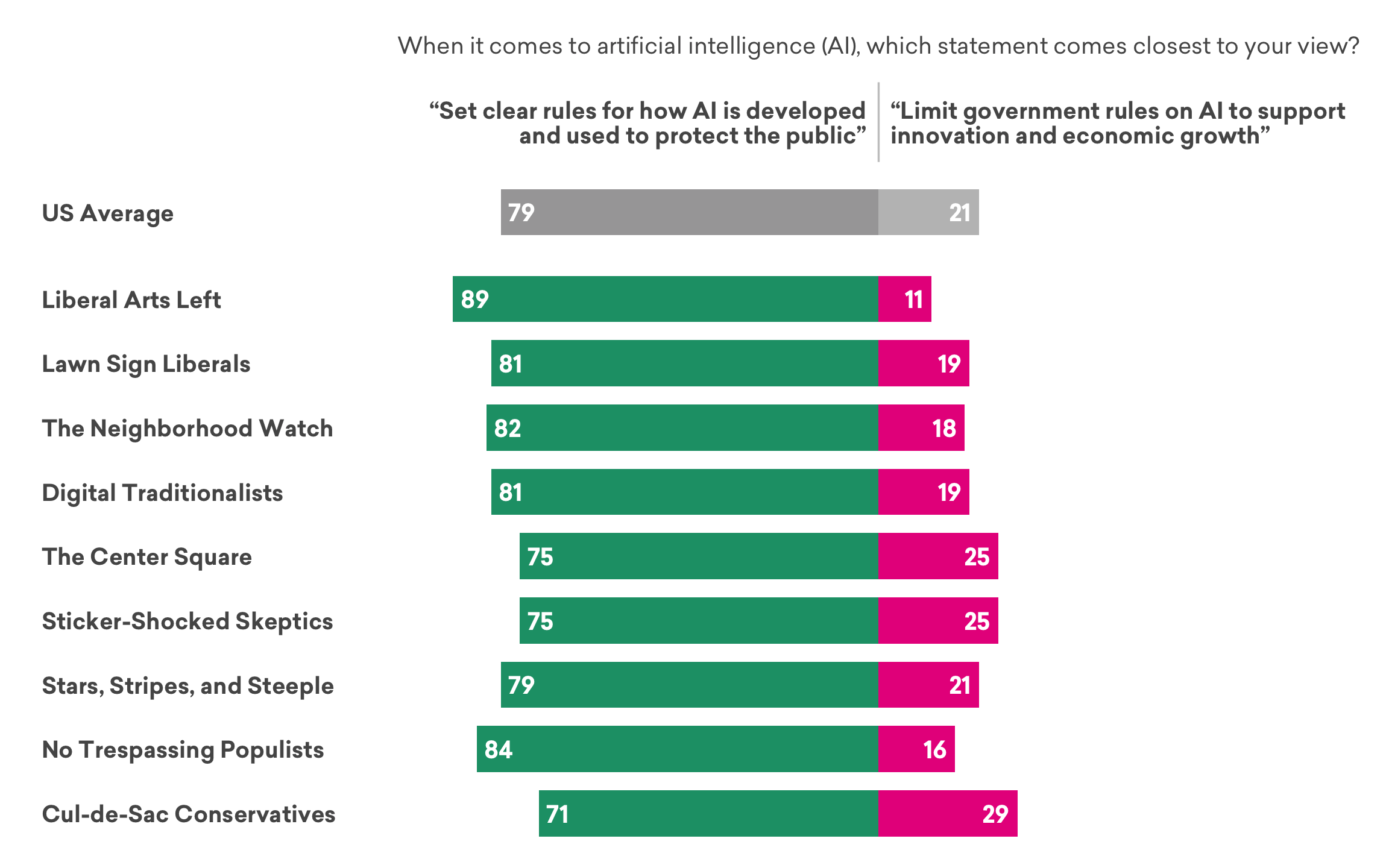
Eight in ten Americans (79 percent), including majorities all of our policy segments, want the government to set clear rules for how AI is developed and used to protect the public.
4. Voters can be surprisingly heterodox in their policy values.
Both Sticker-Shocked Skeptics (conservative-leaning moderates focused on inflation, taxes, health care, and the everyday cost of living) and Lawn Sign Liberals value a more open society while also wanting government to protect the right of parents to decide how to raise their children.
Digital Traditionalists (a young, diverse, and a heavily online group who see the government as both a provider and a protector) are on the opposite end, combining a preference for law and order with the government protecting children’s rights to privacy and choice.
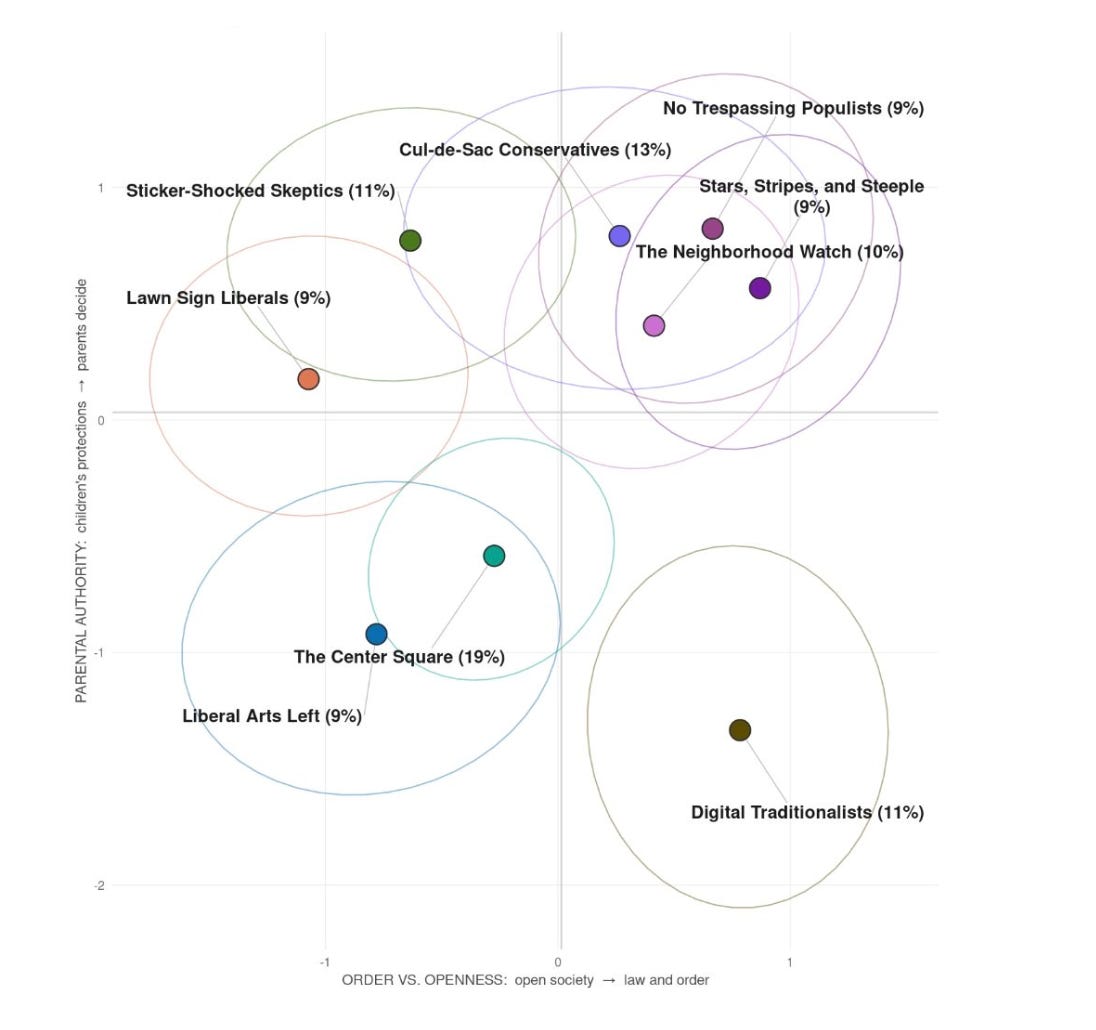
Understanding America’s heterodox policy views
Overall, we see from this project that people do not naturally organize their political thinking into the ideological bundles that partisan politics offers. Americans’ views are more complex. Different people combine values and policy preferences in different ways, and those views vary substantially in their strength, salience, and certainty.
So why is there a surprising amount of heterodoxy in our policy landscape? On some issues, people may hold strong convictions; on others, they may be moderate, ambivalent, uncertain, or simply not care very much. Some Americans may see legitimate tradeoffs between two competing policy goals, others may shift priorities depending on the context, and others may be reasoning from values that do not map neatly onto liberal and conservative camps.
A fuller accounting of America’s policy landscape starts with this complexity. It starts with understanding what problems Americans want to solve in their local communities and across the nation, rather than with where they fit on a left-right spectrum. From there, we can better see where broader areas of agreement exist across traditional ideological lines, and why.
We can’t do this without you!
MIC regularly conducts research to understand the forces driving us apart, find common ground, and help bring Americans together to tackle our shared challenges. Consider supporting our work by making a donation.