
Understanding 'America First' on its own terms

Summary: This month, More in Common released the most comprehensive study of Trump’s 2024 coalition to date. Beyond MAGA outlines four different types of Trump voters, each with distinct identities, competing priorities, and clashing worldviews. Here, Rabhya Mehrotra and Coco Xu examine Trump voters’ reactions to his foreign policy to argue that Trump voters do not understand ‘America First’ as an ideology but rather as a guiding principle. You can read more about our data here.
To hear directly from the researchers behind the report, sign up for our Beyond MAGA webinar on February 12th, 1:30 PM ET. Registration link here.
Since President Trump has deposed Nicolás Maduro and subsequently threatened to take over (and then backed down) Greenland, one of the prominent criticisms has been that such policies aren’t in line with the ‘America First’ philosophy. Thomas Friedman writes in The New York Times that Trump’s pursuit of Greenland reveals that he is “me first.” The Economist observes that as the Administration shifts away from isolationism, “the meaning of ‘America first’ is in flux.” The argument is simple: spending precious American resources on foreign policy adventures is contradictory to prioritizing American domestic interests.
But what exactly is ‘America First’ to Trump voters? At More in Common, we study how Americans perceive (and often misunderstand) each other’s political beliefs. Our latest report, Beyond MAGA, surveys over 18,000 Americans and 10,000 Trump voters in six surveys and dozens of focus groups. We identify four distinct types of Trump voters: MAGA Hardliners, Anti-Woke Conservatives, Mainline Republicans, and the Reluctant Right, each with their own values and motivations.
Despite these groups’ differences, they have a distinct and quite cohesive view of America First — one that complicates the headlines. Rather than seeing America First as an isolationist ideology, Trump’s voters see it as a principle of prioritizing American interests above all. For the President’s voters, America First is more about what can benefit the country and its citizens.
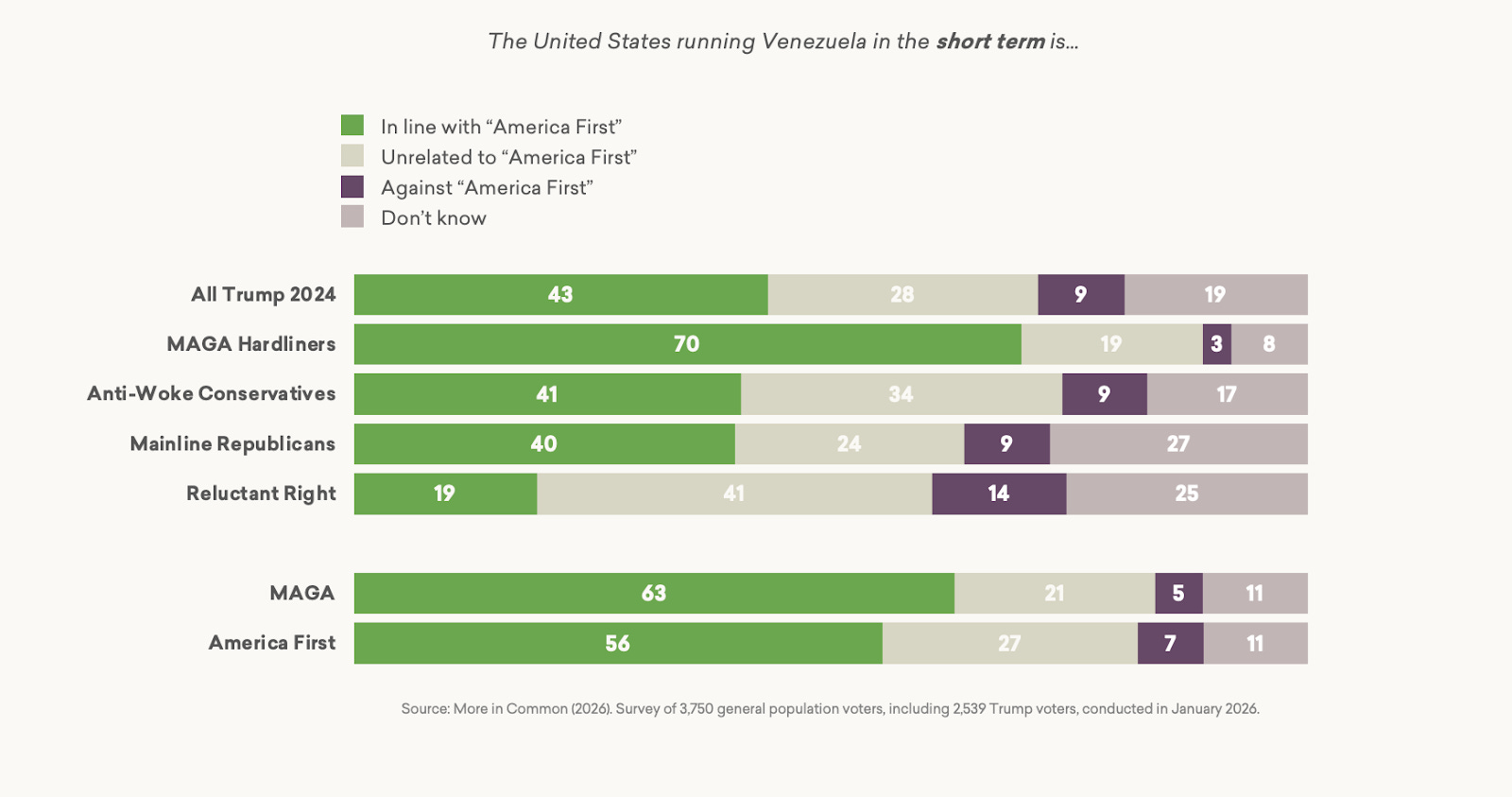
Take Venezuela as an example. Our most recent survey found that Trump voters don’t believe the U.S. military strike in Venezuela contradicts the President’s America First philosophy: less than one in ten Trump voters think that short-term U.S. control of Venezuela is “against America First” principles. Trump voters trust that Maduro’s removal from power in fact advances American interests, believing it would reduce drug trafficking into the U.S. (79 percent), make America safer (74 percent), and increase America’s influence in the Western Hemisphere (70 percent).
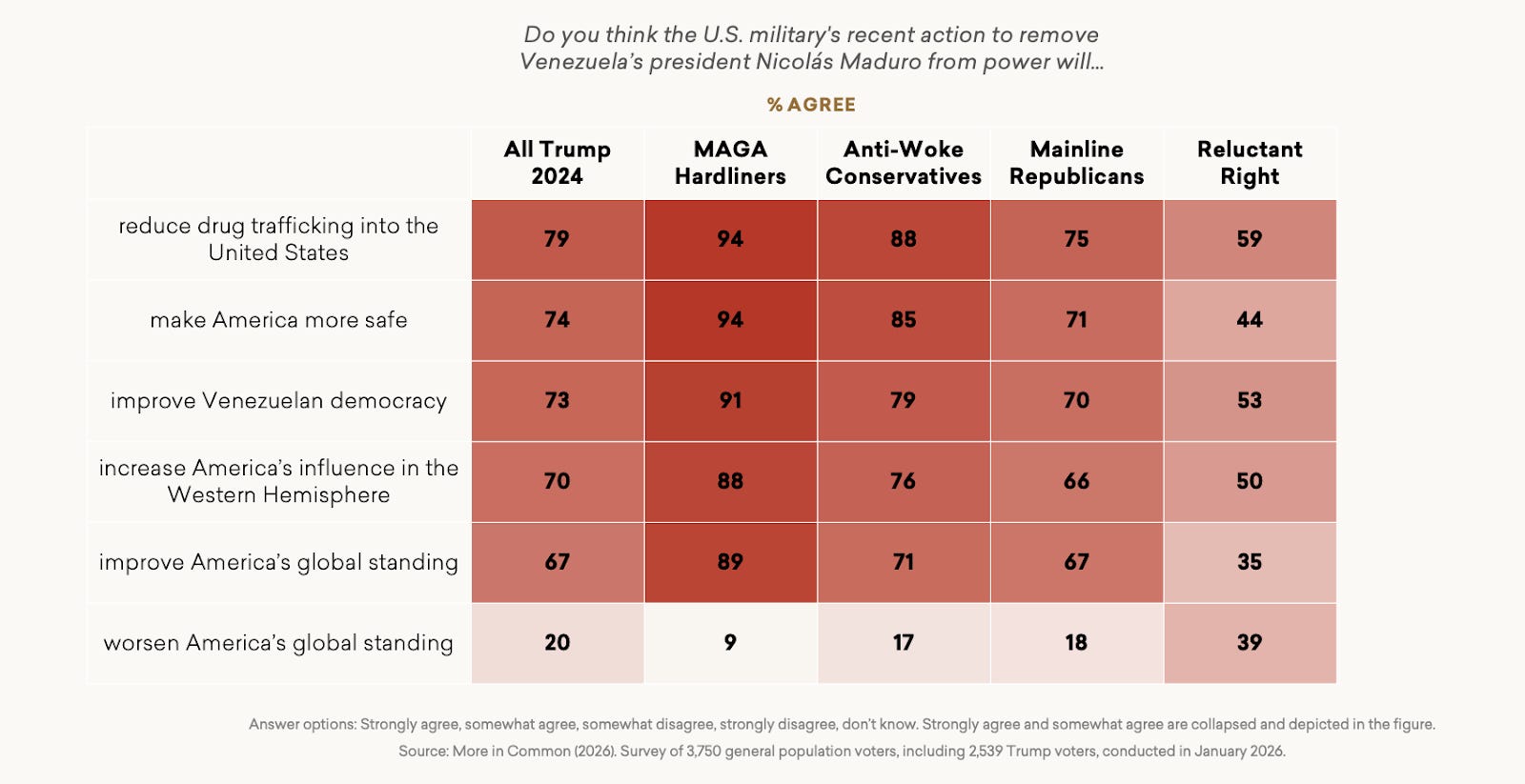
To the President’s voters, the U.S. military strike on Venezuela was not a deviation from, but a successful execution of his campaign promise to make America safer and stronger. Put simply, as long as President Trump can convince his coalition that his policies will advance U.S. interests, they will be seen as consistent with ‘America First’ and receive majority support from his base –– be it isolationism when it comes to NATO or expansionism when it comes to the Americas and Greenland.
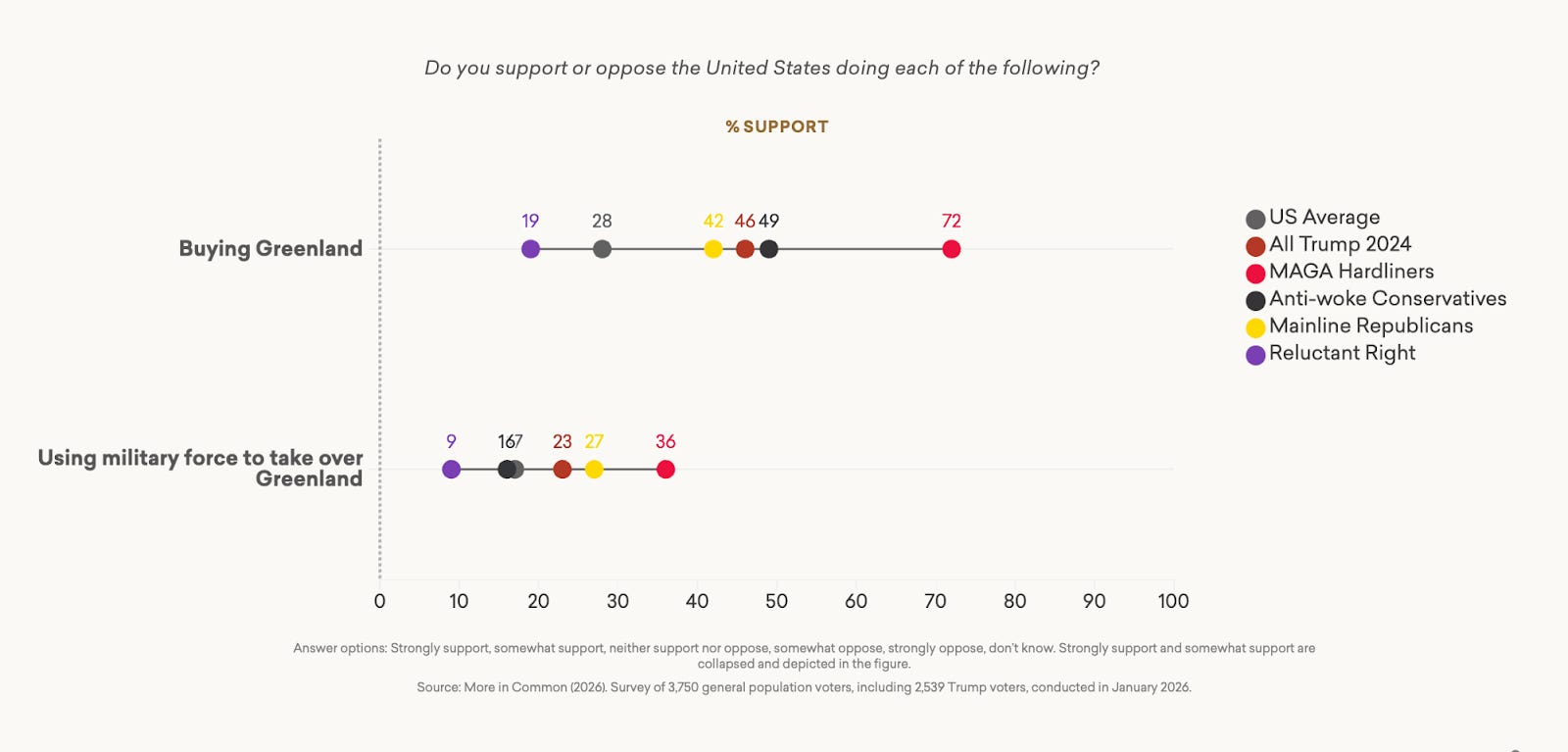
When it comes to Greenland, the case is not yet closed to Trump voters on whether taking over the territory advances American interests and aligns with America First. MAGA Hardliners are overwhelmingly supportive of buying Greenland (75 percent), but Mainline Republicans are less enthusiastic (42 percent) and the Reluctant Right are skeptical (19 percent). The Trump coalition is even less enthusiastic about using military force to capture Greenland: less than one in four Trump voters are supportive. Evidently, the question of whether the pursuit of Greenland benefits or harms American interests was not decisive enough for President Trump to continue.
President Trump’s coalition in 2024 includes 77 million Americans, among them millions of moderates. While not all Trump voters adhere to labels like “MAGA” or “America First,” they do trust that the President prioritizes the needs of Americans. Expecting Trump supporters to abandon him for breaking with America First fundamentally misunderstands why they are drawn to him in the first place.
Rabhya Mehrotra is the Political Analysis and Communications Associate at More in Common. Coco Xu is a Research Manager at More in Common. More in Common’s BeyondMAGA study of over 18,000 Americans can be viewed at BeyondMAGA.us.
To hear directly from the researchers behind the report, sign up for our Beyond MAGA webinar on February 12th, 1:30 PM ET. Registration link here.
We can’t do this without you!
MIC regularly conducts research that sheds light on both cross-group misperceptions and common ground. Consider supporting our work by making a donation.