

This Wednesday, the NFL season kicks off, beginning months of Americans watching, gathering, and talking sports. Few things still bring Americans together quite like football. Of the 100 most-watched telecasts of 2025, 48 were NFL games. Live sports claimed 19 of the top 20 slots, and 18 of those were NFL games. When Americans gather around a screen, it’s often for football.
Ahead of kickoff, we are sharing findings from our recent study with FOX Sports Official, Sports Fandom: Pathway to Community Belonging, on how sports fandom relates to belonging, community engagement, and social connection. From May 28-June 11, 2026, we surveyed 5,572 US adults and sorted them into four groups based on how closely they follow sports: Non-Fans, and Low, Mid, and High Value fans, with High Value fans the most avid.
Here’s what you need to know:
1. Sports are one of the few spaces where Americans still connect across political difference.
As partisan divides deepen, Americans have fewer and fewer places to simply be around people who vote differently. Sports are an exception.
The fan bases of most major sports are split roughly evenly across Democrats, Republicans, and Independents. Combat sports, the NFL, the NBA, college football and basketball, international soccer, and Major League Baseball all draw supporters roughly evenly from across the political spectrum.
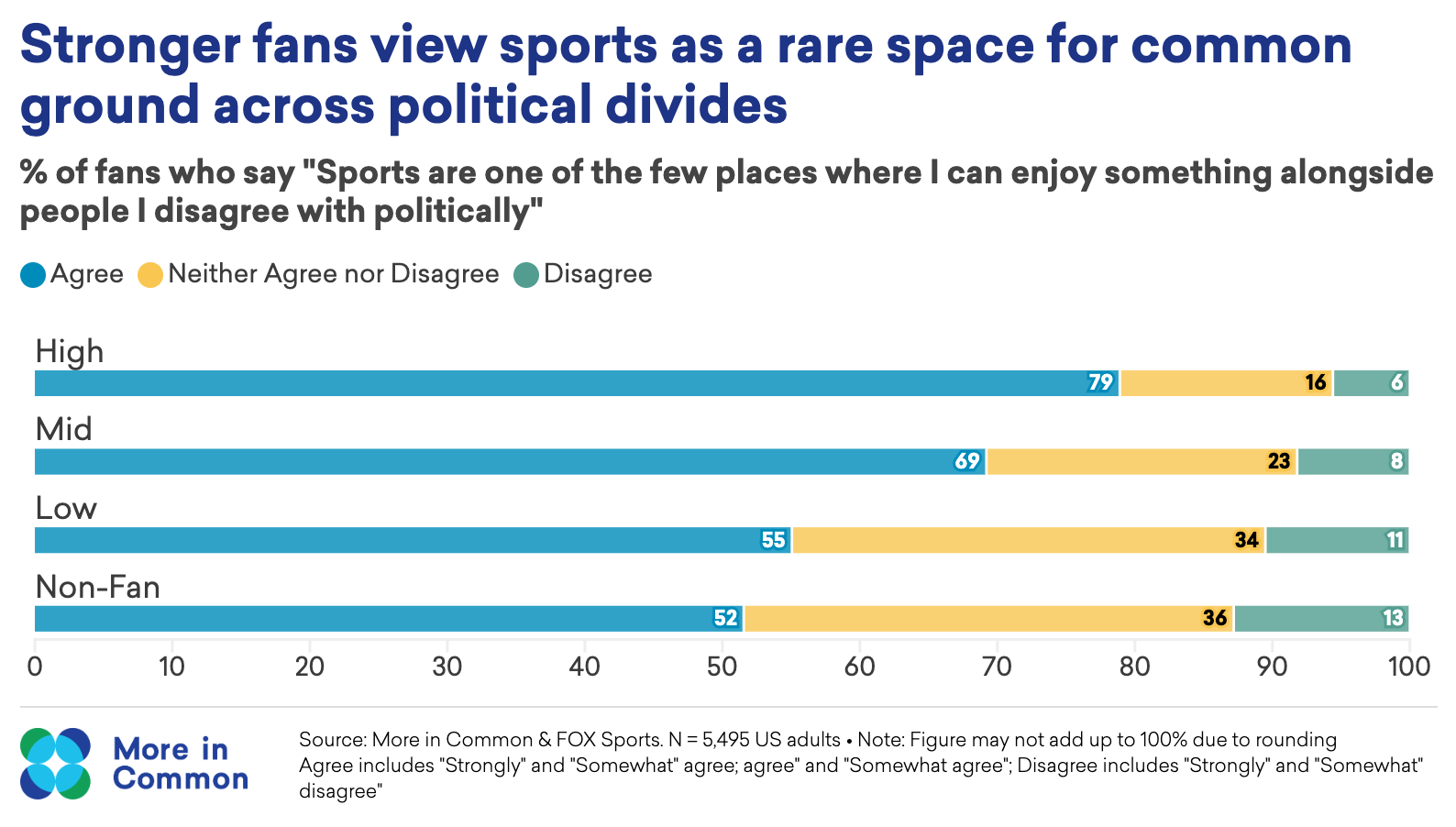
Most people—and High Value fans especially—see sports as a place to enjoy something alongside people they disagree with politically (79 percent of High Value fans, versus 52 percent of Non-Fans).
The stronger the fan, the more interested they are in working across the aisle: 72 percent of High Value fans say they are interested in working toward a shared community goal with someone whose politics differ from theirs, compared to 49 percent of Non-Fans. This replicates a finding from our August 2025 study of sports fans.
Notably, openness to connection across difference grows with fandom. The most avid fans are the most likely to see sports as a place where people on opposite sides can still share something enjoyable.
“I would say [there are] several people who I have met only and solely because we were brought together at a place for sports. I probably would never have met them otherwise, but we were brought together because of a common element which was sports.”
— Elijah, High Value Fan, 62-year-old White man, Republican from Willard, Ohio
“I enjoy the random comments common Joe’s make [about sports] in the setting of strangers. I feel safe sharing views with people I don’t know about a common thread we share.”
— Harriet, Low Value Fan, 65-year-old Black woman, Democrat from Indianapolis, Indiana
2. Fandom is closely linked to community belonging.
Across our data, deeper fandom tracks with a greater presence in community life. Stronger fans tend to be more woven into the places they live.
Belonging rises steadily with fandom: 87 percent of High Value fans agree they belong in their local community, versus 74 percent of Non-Fans.
High and Mid Value fans are more likely to trust their local government (61 percent and 58 percent) than Low Value fans and Non-Fans (46 percent and 45 percent).
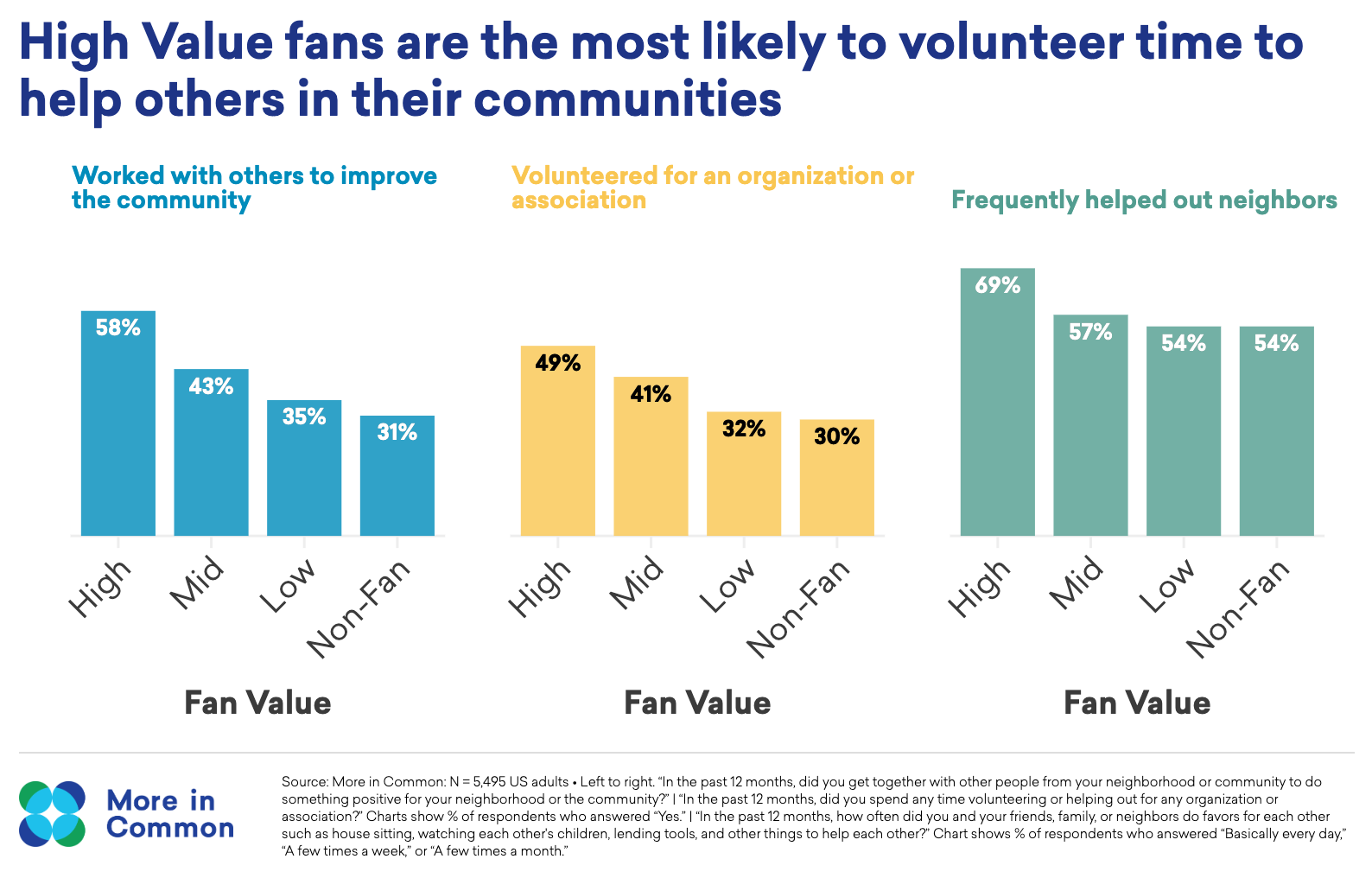
Stronger fans are also the most likely to contribute to the communities where they live: 69 percent of High Value fans frequently help out neighbors, 58 percent have worked with others to improve their community, and 49 percent have volunteered for an organization.
The correlation between fandom and community engagement is consistent across belonging, trust, neighborhood connection, and volunteering. The fans who are most invested in the game tend to be the ones most invested in the community around them.
3. The more fans watch sports with others, the more they feel a sense of belonging in their communities. The barrier to co-fandom, or watching sports with others, is often not having someone to watch with.
Watching sports with others is a low-stakes entry point to a greater sense of belonging.
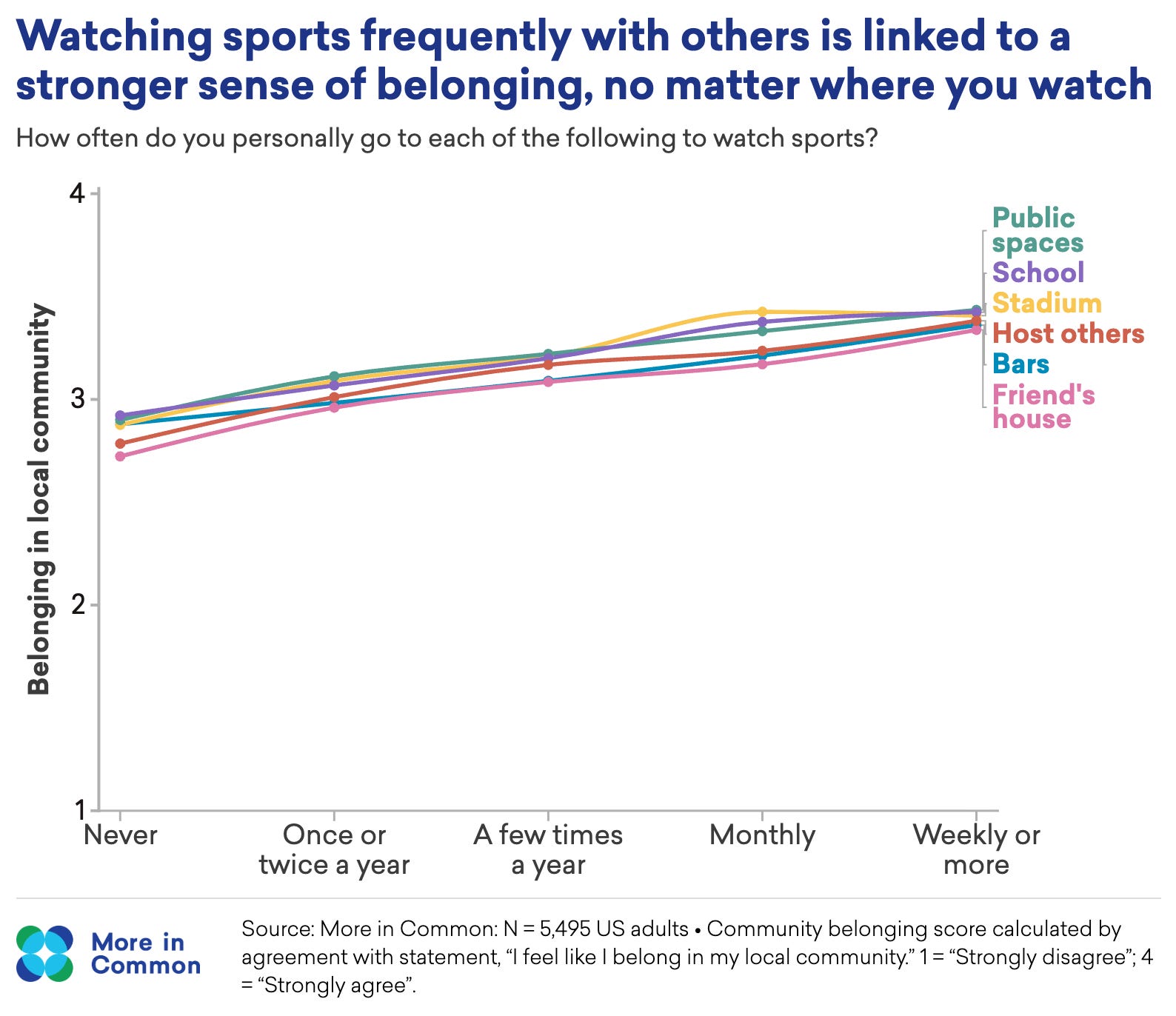
Watching sports with others frequently is linked to a stronger sense of belonging, no matter where people watch—in bars, stadiums, a friend’s house, or public spaces—and regardless of how big a fan they are.
When sports feel central to a town, people report higher feelings of belonging. This relationship is strongest for High Value fans.
The most cited reason that Non-Fans and less avid fans skip sports gatherings is simply not having someone to go with.
Taken together, these data suggest that everyone can benefit from sports fandom. Watching sports with others at a local bar or friend’s house can be an easy way to participate in sports fandom if you’re new to it. If you’re currently a big sports fan, inviting less passionate and non-fans into sports fandom spaces may offer an opportunity to build connection and belonging in your community.
A Sports Season for Connection
The NFL season offers nearly six months of opportunities to gather. Watching sports with others can create shared experiences, which in turn foster repeated outings, traditions, and rituals. Each of these instances keeps people coming back, and, over time, a person’s connection to those around them tends to grow. This season, consider inviting a friend over to watch a game, joining your co-workers for Monday Night Football at the bar, or hosting a tailgate outside the stadium. Chances are you might feel a little more connected to those you’re watching with.
We can’t do this without you!
MIC regularly conducts research to understand the forces driving us apart, find common ground, and help bring Americans together to tackle our shared challenges. Consider supporting our work by making a donation.