
Antisemitism endures while American concern wanes

Summary: In Fall 2023, More in Common US surveyed Americans before and after the October 7 terrorist attack, capturing a widespread increase in American concern about the rise of antisemitism (full 2023 report here). In November 2025, we again asked Americans how much of a problem antisemitism is in the United States, examining whether concern remains high or if it had diminished in the two years since the attack.
Senior Research Manager Emily Gerdin shares these latest findings and reflects on them in light of the recent Bondi Beach attacks.
As a researcher at More in Common, I’m usually in the business of helping organizations turn public opinion into strategic solutions. Today, though, I have a problem and no clear solution.
Concern about antisemitism is waning among Americans, despite antisemitism being an enduring, growing problem globally. I do not have to look far to provide proof of the problem—last weekend, two terrorists killed at least 15 people and injured 27 others attending a Hanukkah celebration at Bondi Beach in Australia. Here in the United States, recent incidents include the April arson attack on Pennsylvania Governor Josh Shapiro’s residence, the May murder of two Israeli embassy workers in Washington, D.C., and the June firebombing in Boulder, Colorado. The American Jewish Committee finds that one in three American Jews reported having been the target of antisemitism in 2024 alone.
This isn’t the newsletter I planned to write. I intended to share a quick update to our 2023 work on changing attitudes towards antisemitism and leave it at that. But after the attack last weekend, it feels important to pause and stress why these findings may be disappointing (even if unsurprising) for many Jewish Americans, myself included.
But first, some context: In 2023, through our partnership with the Jewish Council for Public Affairs, we found that concern for antisemitism rose sharply after the October 7 terrorist attacks: Between September and November 2023, an average of 16% more Americans came to see antisemitism as a problem.
When we re-asked this question for the third time this fall, I hoped that shift might have held. It didn’t. Our latest findings suggest that concern has largely drifted back to where it was before October 7. These are the key takeaways from this new work:
Key Takeaways
1. Two years after October 7, concern about antisemitism has almost returned to pre-attack levels.
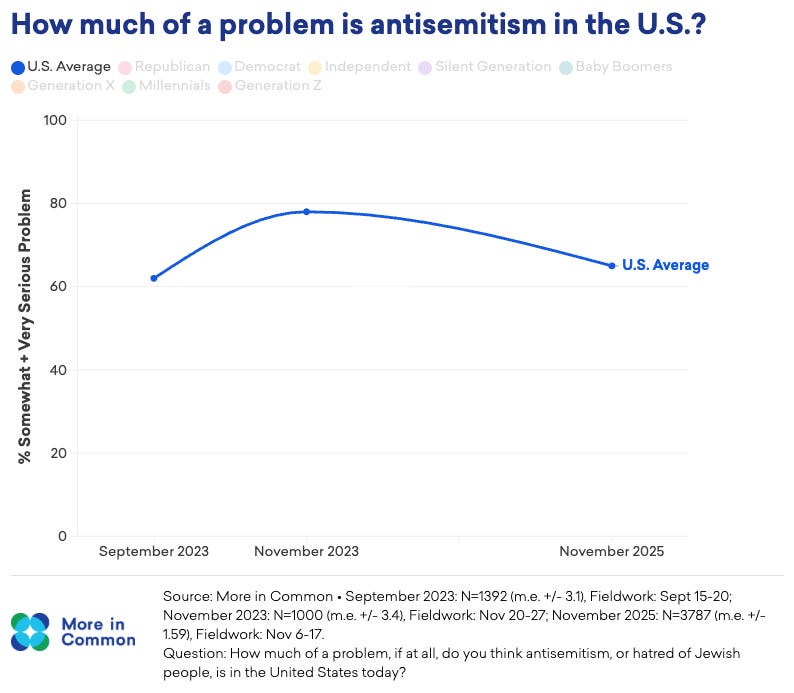
In September 2023, a little over three fifths (62%) of Americans said antisemitism was a somewhat or very serious problem. This rose sharply to over three quarters (78%) in November 2023, but has since fallen under two thirds (65%)—nearly back to pre–October 7 levels.
2. Partisan gaps in concern have narrowed as Republicans are still more concerned than they were pre-10/7.
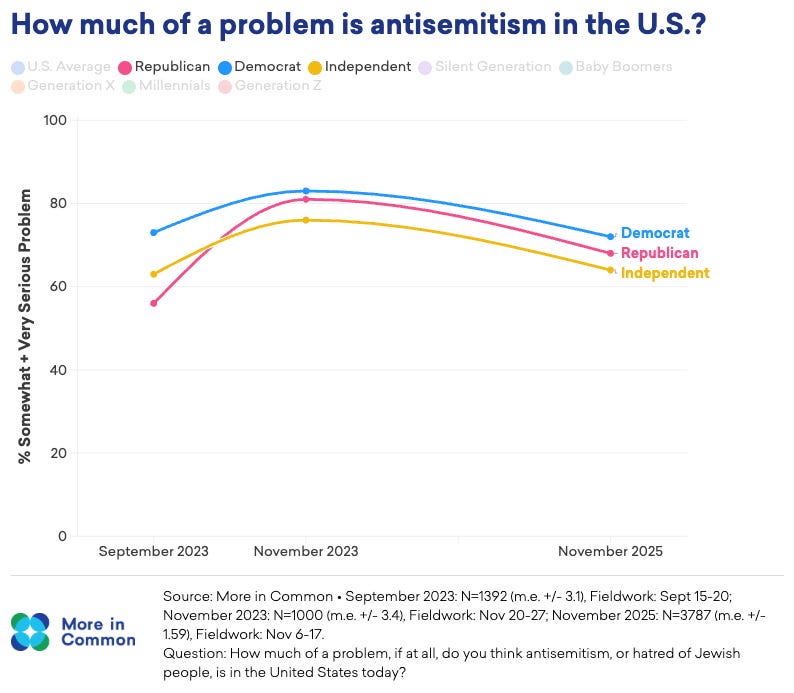
Before October 7, Democrats were significantly more concerned about antisemitism than Republicans. In September 2023, over 7 in 10 (73%) Democrats compared to just over half of Republicans (56%) said antisemitism was a somewhat or very serious problem. Today, concern is similar across parties (72% of Democrats, 68% of Republicans).
3. Younger Americans remain the least concerned, with Millennials showing the largest drop in concern among the generations.
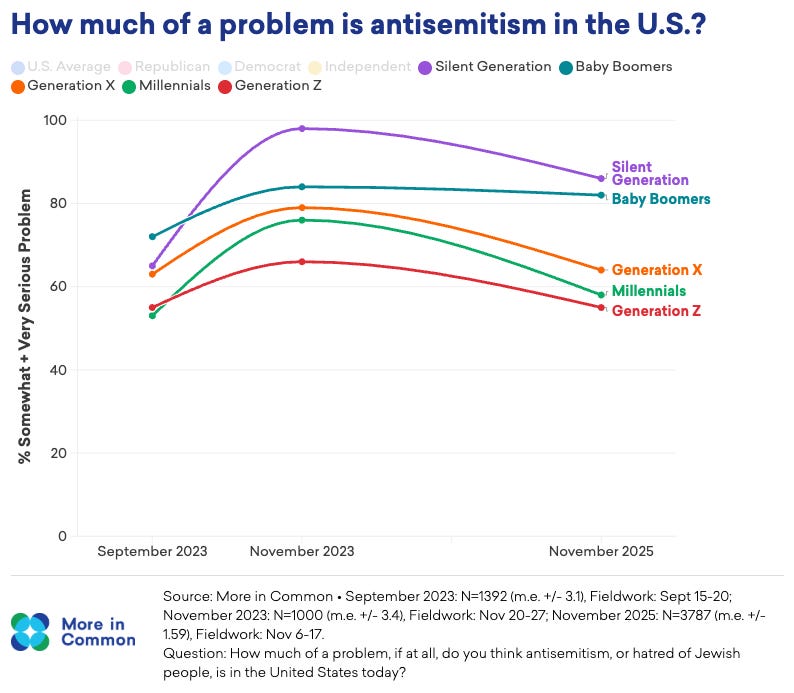
Across all three survey waves, younger generations were less likely than older Americans to view antisemitism as a serious problem. Millennials experienced the steepest decline in concern since November 2023 (76% in November ‘23 to 58% in November ‘25), while Gen Z—whose concern rose the least immediately after October 7 (to 66%)—has returned to its September 2023 level (55%).
What these findings may signal to Jewish Americans
While concern for antisemitism may be declining overall, it remains high within the American Jewish community. In AJC’s fall 2024 survey, more than 9 in 10 American Jews (93%) said antisemitism is a problem, with over half (54%) calling it a serious one.
This unease is not new. As we wrote in our summer 2024 Promising Revelations report on faith in politics in America:
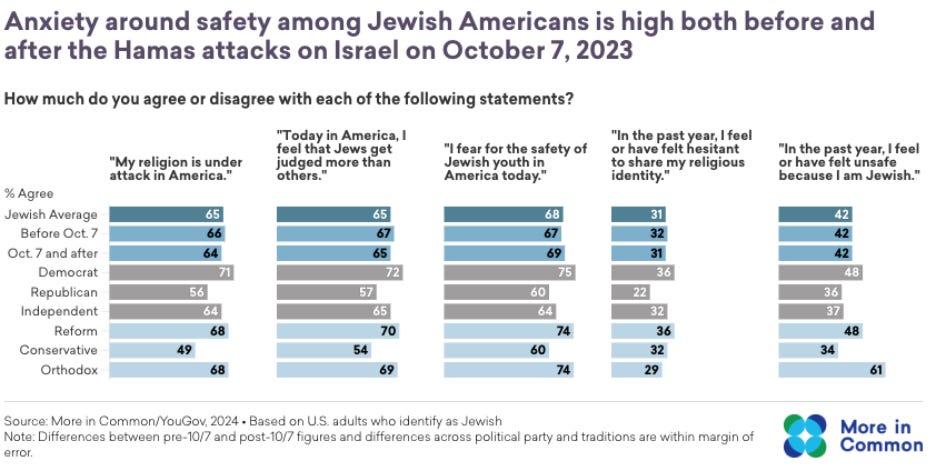
“Even before the Hamas attacks on Israel, many Jewish Americans were already shaken and distressed. Around two thirds of Jewish Americans feel under attack, judged, and fearful for the safety of Jewish youth. Three in ten feel hesitant to share their religious identity, and four in ten have felt unsafe due to being Jewish. The sense of anxiety and concerns with safety have persisted in the weeks following the attacks. Concerns with safety and threats extend across partisan affiliation, Jewish traditions, and demographics.”
As the gap in concern between Jewish and non-Jewish Americans widens, I worry Jewish Americans will feel even more left behind, even less secure in their place in American society, and even less confident about who they can trust.
The Menorah in the Window
As Jews, we are tasked with “publicizing” the miracle of Hanukkah by placing our menorahs in the windows of our homes. Last Thursday—before the Bondi Beach attack—my rabbi emailed our congregation this famous 1931 photograph from Kiel, Germany. His message was clear: if Jews could find the strength to be visible then, we can find it now.
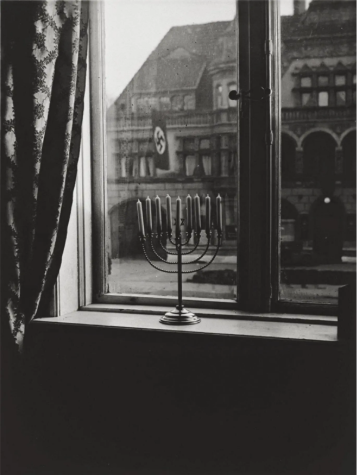
And yet, I find myself wondering whether far fewer Jewish people are displaying their menorahs in their windows this year than last. To be completely honest, I haven’t been. I live on a busy street in a major city, and I don’t trust that everyone who walks by will be friendly towards Jews. I’m walking distance from a Jewish preschool, but you would never know it was a Jewish preschool from looking at the outside. No handmade holiday artwork in the window, no mezuzah on the doorframe, and its name is nowhere to be found on the building. The absence feels deliberate—and telling.
I am not alone in feeling this hesitation. In spring 2024, two Reform Jewish Americans shared similar experiences with us:
“It's scary. It's something that I was thinking about just during this conversation. My sister, like, my niece is, well, now she's one and a half, but she's in daycare. And my sister is really big on, like, doing holiday outfits. And I remember last year for Hanukkah, she's like, I'm afraid to put her in a Hanukkah outfit. And it made me so sad, like, because she had all these cute little, like, you know, dreidel outfits and little. And, like, they're. She wore them at home and took pictures at home, but she's like, I don't want to send her out and, like, into the world because I don't know what people think and, you know, want someone to be treated badly. So it just made me very sad.”
Deborah, 40-year-old white woman, Reform Jewish, moderate Independent from Florida
“It's kind of scary, like, to be outwardly Jewish in your, like, the way you dress or what you wear or things like that. Like, I wear a Star of David, but I don't necessarily wear it, like, outside of my clothes where people can see it, right. Because you never know what someone whose come by to walk past me is going to think or say.”
Ivan, 34-year-old white man, Reform Jewish, slightly liberal Independent from Ohio
As I said at the start—I'm here with a problem, not a solution. With antisemitism growing and concern fading, Jewish Americans will feel increasingly less at home in American society. One of Hanukkah’s central messages is that light will ultimately overcome darkness. For many of us, it’s hard to believe that promise right now.
Jewish Americans need our friends and neighbors to recognize that antisemitism is not only a Jewish problem—it’s an American one. Antisemitism—or any other form of hatred towards a group for that matter — should be an American problem because democracy cannot thrive when people feel forced to hide who they are.
Are you interested in learning more about More in Common’s work on antisemitism? Check out...
Our full report from December 2023 on changing attitudes towards antisemitism in America: Changing Attitudes on Antisemitism in America, Before and After 10/7
This deep dive into the Jewish Americans we surveyed for Promising Revelations report in September 2024
More in Common UK’s excellent work on British attitudes surrounding the Israel-Gaza war, including about concern for antisemitism:
We can’t do this without you!
MIC regularly conducts research that sheds light on both cross-group misperceptions and common ground. Consider supporting our work by making a donation.
This breaks my heart that people of any faith feel unsafe in America. I must admit that before reading this, I didn’t think antisemitism was a serious issue in our country, but if 3/4 of Jewish Americans feel unsafe, then that’s a very large indicator of a very real problem. I will strive to be a better ally.