
An Unexpected Solution to AI Economic Uncertainty

Whether AI ultimately destroys jobs or leads to economic prosperity, concerns about its impact cut across partisanship and demographics. Amid that uncertainty, there is a bipartisan agreement among Americans on one way to respond.
New research conducted by More in Common in partnership with the American Service Project finds that the American public broadly supports national service programs as a potential response to AI-driven economic disruption for young people. For this poll, national service was defined as programs in which young adults spend a defined period working in voluntary, primarily civilian roles such as skilled trades, healthcare, infrastructure, or disaster response.
Here are four key insights.
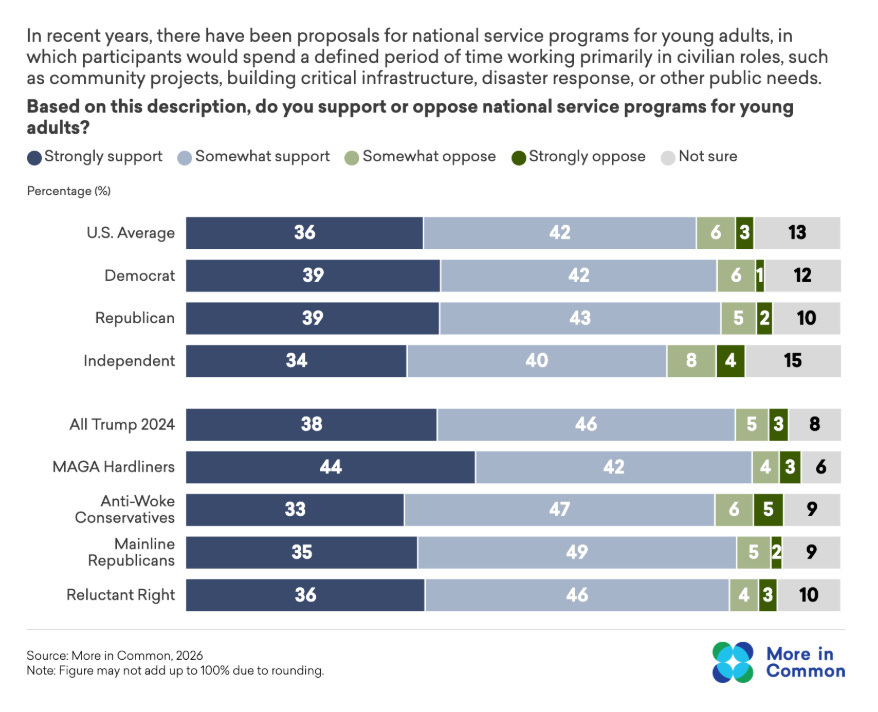
1. National service is one of the rare ideas that draws broad bipartisan support—suggesting attitudes toward it are shaped less by ideology alone and more by how the idea is framed.
When clearly defined as mostly voluntary civilian roles as opposed to mandatory participation, national service programs received bipartisan support. Supporters of national service focused on its perceived benefits, such as building skills, contributing to the country, and providing a sense of purpose.
More than 8 in 10 Democrats and Republicans back national service programs under this definition, including roughly four in ten who strongly support them. While two-thirds (65 percent) of Gen Z Americans support national service, their support is lower than among older generations.
That said, an overwhelming majority of Trump voters (84 percent), including 86 percent of MAGA Hardliners—the fiery core of Trump’s base—and 81 percent of Gen Z Trump voters are supportive of national service.
That support, however, hinges on the voluntary framing. When national service was framed as mandatory, Americans were opposed. Among those who objected, Trump voters in particular cited individual freedom, the right to choose one's own path, and distrust of the federal government's ability or intentions to administer a compulsory program.
2. Americans want the government to play a role in helping young people adapt to AI-driven job loss.
Overwhelming majorities of Americans across political parties believe that AI is very likely or somewhat likely to reduce jobs in the US in the near future.
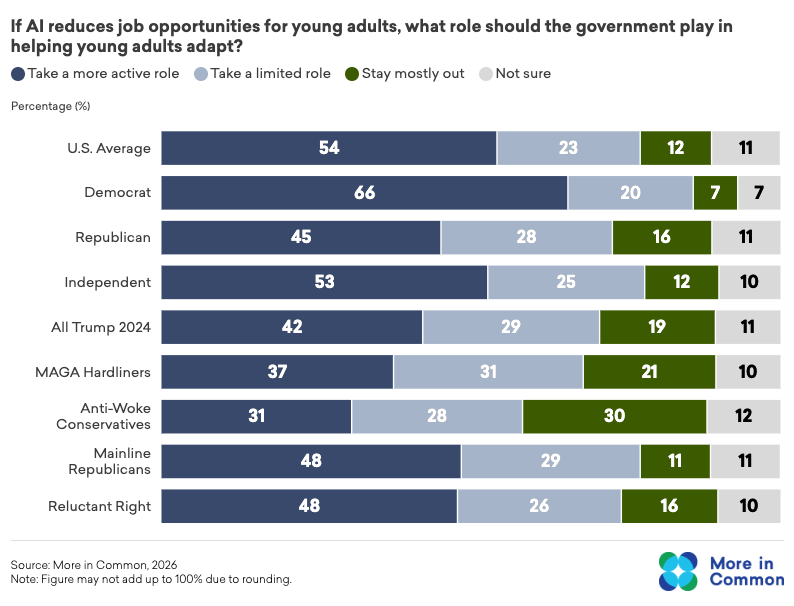
When it comes to addressing this potential job loss, most Americans want the government to play some role in helping young adults adapt to AI-driven job loss. More than three-quarters of Americans (77 percent) support at least some government involvement, including a majority (54 percent) who favor a more active government role.
Notably, Republicans are far more likely to support some level of government involvement than to say the government should stay out entirely (45 percent vs. 16 percent), suggesting that concerns about AI-driven economic disruption may create greater openness to government action than may be assumed.
At the same time, views within the Trump coalition are not uniform. Within the Trump coalition, Mainline Republicans and the Reluctant Right are more supportive of a more active government role, while Anti-Woke Conservatives and MAGA Hardliners are more divided over how involved the government should be in helping young people adapt to AI-related job loss.
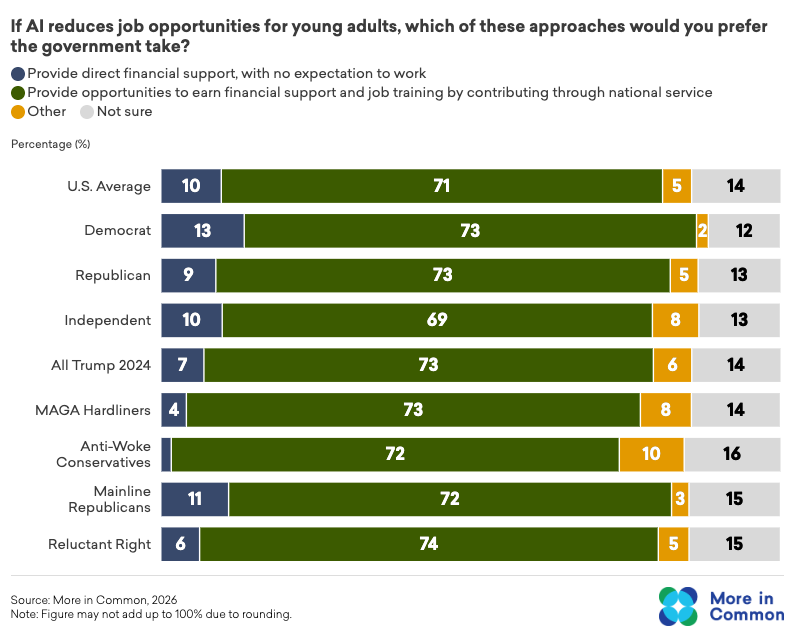
3. Americans are 7 times more likely to support earned financial support and job training through national service than a universal basic income-style solution.
Preference for national service over direct financial support like universal basic income is bipartisan and consistent across Trump’s coalition: seven times as many Americans support the earned benefit as opposed to direct financial assistance.
Across party lines, most Americans believe that in the face of AI-driven job loss, national service could help prepare young adults for future careers (66 percent) and allow them to earn income and benefits to support themselves (55 percent).
4. Americans, including Trump voters, who are most concerned with AI-driven job loss are most supportive of national service.
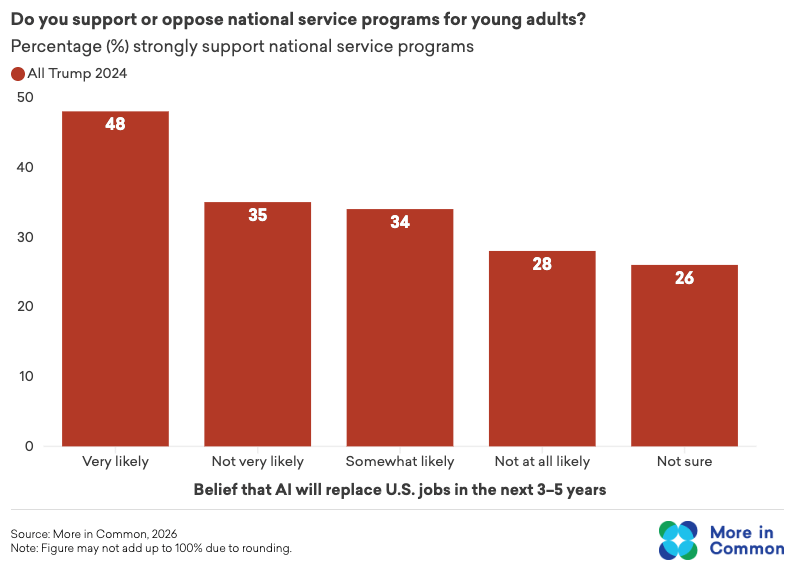
Among those who believe AI will very likely replace jobs in the next 3-5 years, 42 percent strongly support national service programs, suggesting that as AI-driven job loss persists, support for national service may increase.
The same trend holds for Trump voters. Among Trump voters who think AI will very likely replace U.S. jobs, nearly half (48 percent) strongly support national service.
National service has always polled well, but with low-intensity support. This suggests that fears about AI-driven job loss have the potential to intensify support for national service programs.
What does this mean?
Americans across political groups believe AI job disruption is coming and support efforts to help young people adapt.
At a time when few policy ideas generate broad bipartisan agreement, national service stands out as a rare area of common ground. More than 8 in 10 Democrats and Republicans support national service. And Americans are most supportive of a program that is voluntary and civilian-focused.
The findings also suggest that Americans may be more aligned than is often assumed on both economic concerns and how to navigate future disruption. Across political groups, support was strongest for responses that emphasize agency and contribution over passive assistance, preparing young people to succeed rather than simply cushioning the effects of change.
As concerns about AI-driven job loss grow, national service may represent a rare bipartisan opening: a response to economic disruption that resonates not only because of what it provides, but because of what it asks of people in return.
About American Service Project
American Service Project is a new organization built to reimagine national service as critical infrastructure for the AI transition, and to translate public support into durable policy and political power that meets the greatest needs and challenges facing our country and the next generation. Follow American Service Project’s work at americanserviceproject.org.
We can’t do this without you!
MIC regularly conducts research that sheds light on both cross-group misperceptions and common ground. Consider supporting our work by making a donation.